Metal Roof Retrofits- Insulate the weakness?
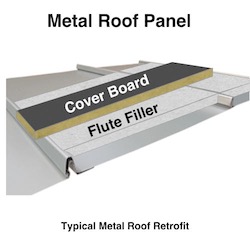
The most popular solution is adding some insulation and retrofitting a new roof membrane over the top. This is were roof insulation Flute Fillers play an important role. Not only do they add R-value to the system but they can transition a flat surface for a new roof retrofit system. I typically see flute filler level with the top of the ribs/seams and one additional layer on top of that smoothly bridging the top of the ribs/seams. The question is can this system be improved upon?
The one area of thermal weakness in this system is where the original metal roof has seams (connection point of the two pieces of metal roof) that allow heat loss at those points. By installing only one layer of insulation over these seams, it allows for the potential of thermal loss at these junctures were the insulation joints meet these metal roof seams. This thermal loss could cause condensation and stress the membrane disproportionately causing future issues.

Some may say, there is insulation under the metal roof system already, those joints don't leak heat. Really? Take an infrared camera and scan that metal roof and look at the seams, you might be surprised what you find.
There are two solutions to fix this potential problem with retrofitting over a metal roof. The first solution is to add another layer of insulation and offset the joints. The second solution is to use Plymouth Foams RetroDeck™ with a cover board. This system has a built in seam offset. No roofing system is perfect, but eliminating as many potential problems can help a roof system last longer creating better value for our customers.
Stopping Condensation in Metal Roof - What's the Secret?
The biggest concern of condensation and its effects can be quit worrying for building owners and construction professionals. Water that forms in a system can cause damage such as:
✓ Corrosion of metal panels and components which can structural weaken the system
✓ Degraded and wet insulation reducing thermal performance
✓ Mold and/or mildew growth that can increase health risks
✓ Insect infestation which can contaminate systems
Condensation tends to occur in noticeable quantities and cause problems at surfaces where there is a sudden change of permeance, which causes an increase in local relative humidity sufficient to create dew point conditions. Condensation in metal roofs can be caused by air leaks around units, holes in vapor barriers/retarders, gaps in insulation just to name a few and no system is bullet proof. “Moisture moves by several mechanisms, including bulk drainage, diffusion (absorption), surface diffusion (absorption), capillarity, osmosis and convection.”

Condensation can occurs on a hygroscopic surface, such as wooden sheathing or insulation, then moisture is absorbed, lowering the vapor pressure and increasing the vapor pressure gradient, driving more moisture toward that surface.
Picking an insulation that is resistant to moisture and help stop condensation is important, but no insulation is 100% waterproof. When Polyisocyanurate (Polyiso/ISO) or Extruded Polystyrene (XPS) gets wet, they dramatically loss their thermal effectiveness. Engineered Expanded Polystyrene (EPS) has the ability to resist moisture but when it get wet has the ability to expel moisture. Most metal roofing systems are not waterproof but rather watersheds. Therefore, air can travel and flow through the upper metal roof system allowing drying to occur. Learn More Here is the Secret: EPS is the BEST Insulation Solution for Metal Roofs because it can expel moisture caused by condensation. EPS's R-value will stay stable and be an overall better value.
View our Metal Roofing Products
The Perfect Continous Insulation System
Continuous Insulation, is defined as, “insulation that is continuous across all structural members without thermal bridges other than fasteners and service openings.” More important is the fact that Continuous Insulation increases R-value performance due to the non-interruption of wooden or steel studs.

“Furring out” a wall with studs or furring strips and then filling in the gaps with insulation is still a common method used on interior and exterior walls. Every stud used, lowers the R-value and thermal loss and/or thermal bridging occurs at this intersections. Advancement in understanding performance R-value through continuous insulation has lead to the importance of Gold-Wall. The advantage of Gold-Wall is not only a Continuous Insulation system, but it has the built in ability to allow for finishing attachments. These finishing attachments can be interior drywall or exterior clad siding like vinyl or steel. The possibilities are almost endless.
Gold-Wall, with its built in surface attachment stud, can be installed easily to most type of masonry walls. Gold-Wall can also be attached to steel studs, wood framing or even OSB/Plywood surfaces. Gold-Wall comes with a high performance poly facer laminated to the moisture resistant EPS foam board which increases durability, fastener holding and impact resistance.
Gold-Wall may be perfect for your next Continuous Insulation project. Learn More